Experimenting!
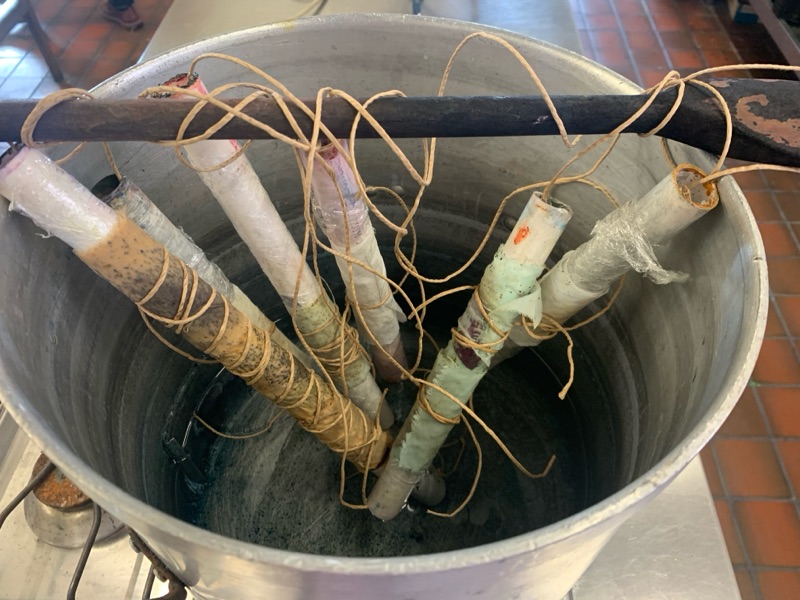
An exciting step in the project! Finally starting the natural dye techniques at University.
What we have in the photos above:
2% weight of the fabric (in grams) of copper powder and another of iron powder went into two separate pan of hot water. I boiled silk, and cotton in these solutions in a process called 'mordanting'.
Mordant - A mordant or dye fixative is a substance used to set dyes on fabrics by forming a coordination complex with the dye, which then attaches to the fabric. It may be used for dyeing fabrics or for intensifying stains in cell or tissue preparations.
So I had 4 types of fabric to test: silk treated with copper, silk treated with iron, Cotton with copper, and cotton with iron. All fabrics were cut to be thin strips to reduce waste for these samples.
Following this process, I then foraged around for leaves and petals that I could find on campus. I was mainly looking for softer thin leaves that would transfer the colour much easier than waxy feeling leaves that have a barrier to protect loss of chlorophyll - the green pigment in plants.
I then placed the fabrics down and put the plants on in a specific matched order so I could see the differences between each print easier. Finally, I simply rolled them all up around a small wooden stick and had it steamed for an hour or so. Once steamed you let the samples cool for 15 minutes, unroll them, let them air-dry then wash any dirt away. That's it!
Findings:
(What went wrong/could be changed)
(What went well)
* The boiling of the fabrics isn't needed, just soaking the fabrics in room temp water will suffice, and perhaps have a less stained effect on the finished sample.
* Sprinkled tea worked brilliantly on both fabrics and on both mordant solutions. I found it was more effective and preferred the colour coordination of the copper/silk fabrics.
*The fabric being wet when the plants went on caused a lot of bleeding and a more organic print rather than a more photographic print. Depending on the desired effect, you could dry the fabric after soaking it in your metallic solution, and then steam the plant matter onto dry fabric.
*Silk was a better print when wet - may be different when I redo the process on dry fabric, but for now I love the silk feel. Perhaps explore linen too to be more eco-friendly?
Overall it is noteworthy that my original colour palette is being echoed here through these samples subtly. That pale blue tone in the petal comes out in the copper, the oranges from pollen come out with iron and rust, and the red tones within the tea reflect my garden berry samples from previous posts. I will be using this to make a second colour palette to show the secondary, more washed out colours in these samples.
Links for today:
Bitesize chemistry of natural dyes - https://youtu.be/Gwk1B66dvAM
Eco-Printing with Jennifer Johnson - https://youtu.be/UIHPsK4SdpU
Food-waste Bundle dye by Billy Nou - https://youtu.be/9G64jioXlnI


Comments
Post a Comment